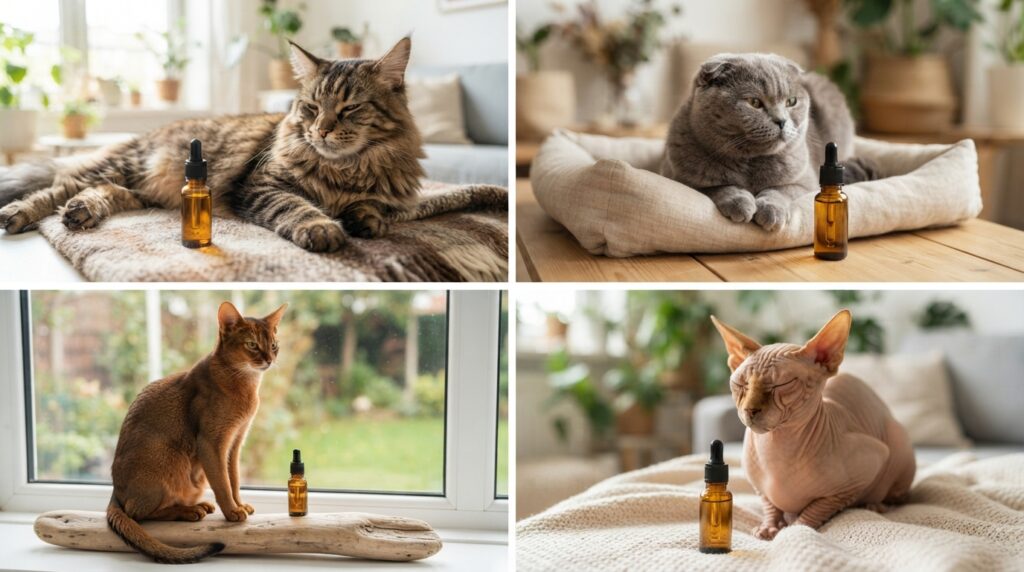
Walk into a pet store today and a small amber bottle with a hemp leaf on the label is hard to miss. The aisle looks crowded, the promises look big, and the price tags swing wildly.
Cat owners who pause at that shelf usually have one question in mind. Is CBD oil for cats a reasonable thing to try, or an expensive dropper of carrier oil? The answer depends on the product, the individual cat, and what a veterinarian says.
What follows covers what the product is, what research exists, and how to shop without getting talked into anything. Each section stands on its own, so jump around if that helps.
What Cat Owners Should Know First
A Quick Look at the Product
CBD is short for cannabidiol, one of more than 100 cannabinoids found in the cannabis plant. Pet products are normally made from hemp, which the 2018 U.S. Farm Bill defines as cannabis with no more than 0.3 percent delta-9 THC by dry weight. The extract is blended into a carrier oil such as MCT oil, hemp seed oil, or fish oil, then bottled with a dropper.
Oils remain the most common format for cats because a dropper allows small adjustments. Chews, treats, and skin balms exist too, but chews are harder to portion for an animal that often weighs between eight and twelve pounds.
What Research Exists
Human medicine has exactly one approved CBD drug. The FDA cleared Epidiolex in June 2018 for certain rare seizure disorders. No CBD product holds FDA approval for cats, and the agency’s Center for Veterinary Medicine has said it cannot state that such products are safe for animals.
Feline studies are few and small. A 2019 paper in the journal Animals followed how dogs and cats absorb a CBD-rich hemp product, and a 2021 paper in the Journal of Feline Medicine and Surgery looked at tolerability in healthy cats given rising doses. Both ran for short periods. Most of the pain and arthritis findings come from dogs, including a 2018 Cornell University study in Frontiers in Veterinary Science.
Why Cats Are Not Small Dogs
Cats handle certain compounds in unusual ways. Their livers produce limited amounts of some enzymes involved in glucuronidation, which is a main reason acetaminophen is dangerous to them. Researchers have not shown that this makes CBD harmful, but it explains why veterinarians hesitate to copy dog data onto cats.
Size matters as well. A bottle designed for a 70-pound dog can deliver a hefty amount to a nine-pound cat in only a few drops. Strength per milliliter, not bottle size, is the number worth reading.
Why So Many Brands Exist
Money explains most of it. The American Pet Products Association (APPA) reported that U.S. pet spending reached $136.8 billion in 2022, and its 2021-2022 survey counted roughly 45 million households with a cat. CBD arrived in the pet aisle soon after the 2018 Farm Bill cleared the way for hemp.
Low barriers to entry followed. Few federal rules govern pet supplement labeling, so quality ranges from carefully tested products to bottles with no verified contents.
How to Shop Without Guesswork
Start with the Certificate of Analysis
A certificate of analysis, usually shortened to COA, is a lab report tied to one production batch. A useful one lists CBD and THC content and shows results for heavy metals, pesticides, residual solvents, and microbes. The lab should be independent of the brand, and accreditation under ISO/IEC 17025 is a good sign.
Match the batch number on the report to the number printed on the bottle. If a brand promises a lab report on request and then goes quiet, that silence answers the question. Some companies print a QR code that opens the report in seconds, which makes checking easy.
Read the Ingredient Panel
Shorter lists tend to be better. Hemp extract, a named carrier oil, and perhaps a natural flavor such as salmon cover most good products. Skip anything with xylitol or other additives that have no purpose in a cat’s diet, along with essential oils such as tea tree, which are risky for cats even in small amounts.
Cats cannot taste sweetness because they lack a working sweet taste receptor, so sugary flavors are pointless. Human tinctures often contain alcohol, mint, or citrus oils that cats dislike or tolerate poorly.
Screen the Claims
A quick filter for labels and product pages:
- A bottle claiming to cure cancer, kidney disease, or diabetes is making a drug claim. The FDA has sent warning letters to companies over this kind of language.
- Phrases like hemp extract 500 mg with no CBD amount per serving make dose math impossible.
- A THC-free label with no lab report behind it is only a sentence.
- Reviews hosted on the brand’s own site are marketing, not evidence.
If two or more of these show up, move on.
Look for Quality Seals
The National Animal Supplement Council (NASC), founded in 2001, runs a Quality Seal program that audits manufacturers for labeling, adverse event reporting, and manufacturing practices. A seal does not guarantee results, but it shows a company submitted to outside review.
Pair it with a COA rather than treating either one as enough. Good manufacturing practice (GMP) language on a label is also worth a glance, though it stays a claim until an auditor confirms it.
Using It Safely at Home
Talk to a Vet First
Cats taking medication for the heart, thyroid, seizures, or pain have the most to gain from a conversation. CBD is processed by liver enzymes in the cytochrome P450 family, which also handle many drugs, so interactions are possible. A vet can check liver values before and after starting, which matters because raised alkaline phosphatase (ALP) was reported in some dog studies.
A cat that has skipped meals for a day should be examined before any supplement is considered. Appetite loss in cats can turn serious quickly.
Start Slow and Keep Notes
No official dose exists for cats, so the vet’s guidance comes first. Many veterinarians suggest beginning with a very small amount and waiting several days before any change.
A simple notebook works well: date, product, amount, appetite, litter box habits, energy, anything odd. Photograph the label and batch number too. Notes make the next appointment far more useful than a general impression.
Know the Warning Signs
Drooling, vomiting, wobbly walking, unusual sleepiness, or sudden hiding can point to a poor fit, too much product, or THC contamination. THC is the cannabis compound that is toxic to cats, and signs can include dilated pupils and loss of coordination.
Stop the product and call a vet or the ASPCA Animal Poison Control Center if any of these appear.
Final Thoughts
CBD oil for cats sits in a gray area: popular, lightly studied, and unapproved by the FDA. Shoppers who verify lab reports, read ingredient lists, and involve a vet lower their risk considerably. A slow start with written notes beats any bold label. When a cat’s health is on the line, evidence should outrank packaging.